ADA Title II · April 26, 2027 · — days left
Every PDF you publish, readable by everyone.
Verso uses Claude to rebuild inaccessible PDFs the way a remediation specialist would, then proves the result with WCAG checks and sends anything uncertain to a person. Minutes per document, not weeks.
Free to try. No account needed.
Product demo: Verso remediating a lecture handout
Before
What a screen reader hears today
“BIOL 2210 · Lecture 7 handout Lecture 7: Cellular Respiration How cells convert the chemical energy in glucose into ATP. Overview Cellular respiration is…”
“C 6 H 12 O 6 + 6 O 2 → 6 CO 2 + 6 H 2 O + energy”
[figure: nothing announced]
“1”
- No tags
- No title
- No language
- Figure has no alt text
- accessibility score
- 12 → 98accessibility score
- words preserved
- 252 / 252words preserved
- elements tagged, artifacts hidden
- 9 + 2elements tagged, artifacts hidden
- item flagged for a person, with a reason
- 1item flagged for a person, with a reason
Page 1 of the lecture handout demo, which you can open and inspect in the app.
The problem
The deadline is fixed. The PDF backlog isn’t getting smaller.
A single course holds dozens of syllabi, handouts, slide exports and scanned readings. A city posts agendas, budgets and notices every week. Most were never tagged, so to a blind student or resident they’re a wall of unordered text, or nothing at all. Fixing them by hand means tagging each file element by element in Acrobat.
- Apr 26, 2027
- Compliance date for public entities serving 50,000+ people under the DOJ’s ADA Title II rule. Posted documents must meet WCAG 2.1 AA. Smaller entities follow in 2028.
- $20M
- What one vendor quoted Ohio State’s libraries, at $5 a page, to fix more than 110,000 noncompliant PDFs. There was no budget for it.
- 1–2 people
- Nearly half of U.S. universities have one or two staff working on technology accessibility. The rule came with no federal funding.
Sources: U.S. DOJ, 28 CFR Part 35 Subpart H, and the April 2026 interim final rule; Inside Higher Ed, “Higher Ed Prepares for New Era of Accessibility” (January 2026), citing an Educause survey.
The math
What your backlog costs to fix.
Remediation is priced per page because it’s skilled, manual work: every heading tagged, every table cell given a header, every chart described. Drag the slider to size yours.
- Outsourced to a vendor
- $125KAt $5 a page, the low end of vendor quotes. Weeks per batch.
- Done in-house, in Acrobat
- 1,667 hoursAt about 15 pages an hour for a trained specialist.
- With Verso
- $10KAt $0.40 a page. Machine time is minutes; people review only what’s flagged.
Vendor list prices run about $4 to $12 a page. Ohio State’s libraries were quoted $5 a page, about $20 million, for their noncompliant PDFs (Inside Higher Ed, 2026). Specialist throughput of 10 to 20 pages an hour is a common industry estimate.
How it works
Remediation as a pipeline, not a person in Acrobat.
Step 1
Drop in the backlog
Upload a PDF and Verso audits the original first, so you see exactly what a screen reader gets today.
Step 2
Claude reads every page
Each page is read as an image and as the PDF’s text layer. Claude rebuilds headings, lists, tables, figures and equations in true reading order.
Step 3
Verso verifies the result
Twelve WCAG and PDF/UA checks run on every document, plus a word-level fidelity check that shows nothing was dropped or invented.
Step 4
People review what’s uncertain
Anything Claude had to guess, like a chart’s exact values, goes to a review queue with the reason. Everything else is ready to publish.
Before and after
Hear the difference structure makes.
Verso includes a screen reader preview for every document and can read it aloud. Here’s page one of the two-column lecture handout, as an assistive technology user experiences it.
“BIOL 2210 · Lecture 7 handout Lecture 7: Cellular Respiration How cells convert the chemical energy in glucose into ATP. Overview Cellular respiration is a series of redox…”
“C 6 H 12 O 6 + 6 O 2 → 6 CO 2 + 6 H 2 O + energy”
“…producing NADH, FADH 2 , and 2 ATP per glucose. 4. Oxidative phosphorylation…”
[figure skipped: nothing announced]
“1”
- No headings, so nothing to navigate by
- Running header and page number read as content
- The diagram doesn’t exist for a blind student
- H1Heading level 1, Lecture 7: Cellular Respiration
- H2Heading level 2, Overview
- MathMath, C 6 H 12 O 6 plus 6 O 2 yields 6 C O 2 plus 6 H 2 O plus energy
- ListList with 4 items. 1. Glycolysis (cytoplasm)… 4. Oxidative phosphorylation…
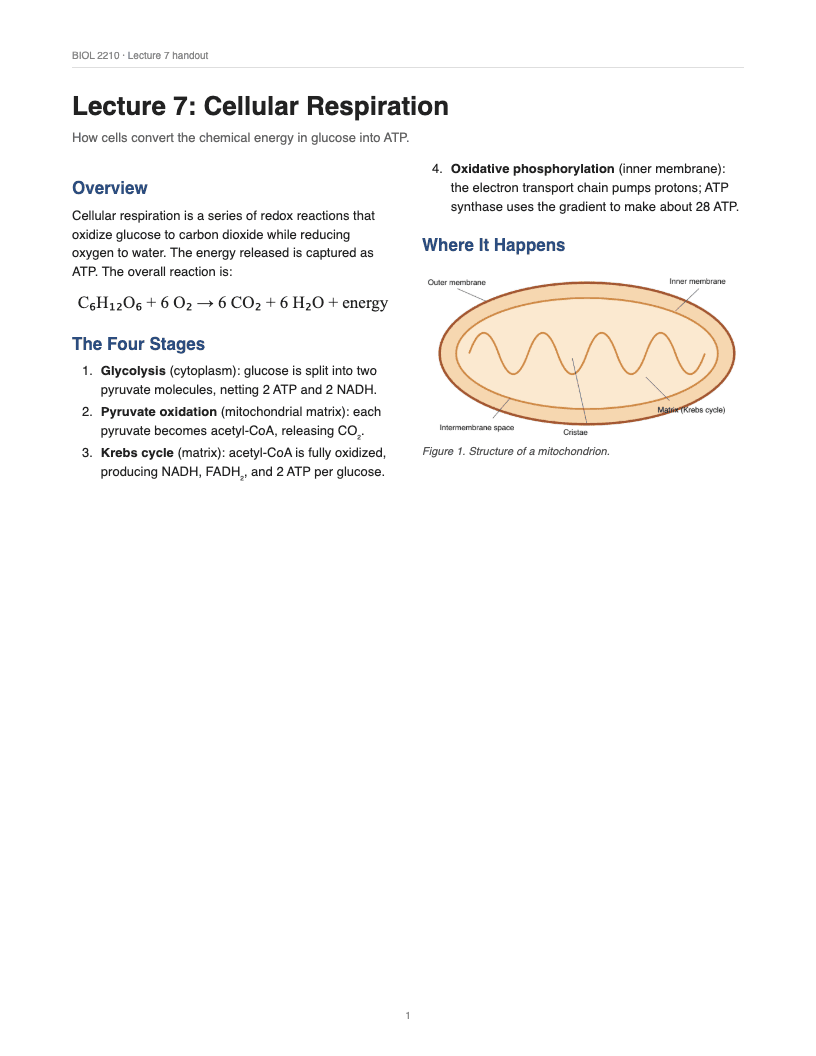
- GraphicGraphic, labeled diagram of a mitochondrion showing where each stage of respiration occurs. Has description.
- Navigable outline, one H1, no skipped levels
- Equation spoken correctly, list joined across columns
- Diagram described in the context of the lecture
What it handles
Everything a remediation specialist does, at the speed of an API.
Reading order across columns
Multi-column layouts, sidebars and callouts are read the way a sighted reader moves through the page.
Real data tables
Column and row headers, captions, and spanning headers split so every cell is announced with its header.
Alt text that knows the subject
Charts get a long description with every series and value. Logos get the organization’s name. Decorative art is hidden.
Math and STEM
Equations become LaTeX and MathML plus a spoken reading, so chemistry, physics and statistics handouts work too.
Scanned documents
No text layer? Claude reads the page image directly, including old photocopied readings.
Tagged PDF, HTML and Markdown
Export a tagged PDF with bookmarks, a responsive accessible web page, or Markdown for your LMS.
Evidence for compliance
A before-and-after conformance report with every check, the fidelity score and the reviewer decisions.
Screen reader preview
Hear a document read aloud before you publish it. It’s the fastest way to build intuition across a team.
The alternatives
Specialist quality, without the specialist queue.
Most institutions will still send their hardest forms to specialists. Verso is for everything else: the long tail of handouts, syllabi and notices that no one has hours for.
| Capability | Outsourced specialists | Acrobat auto-tag | Verso |
|---|---|---|---|
| Fixes the file itself | |||
| Turnaround | Weeks | Minutes, then manual cleanup | Minutes |
| Cost per page | $4–$12 | Specialist hours | $0.40 |
| Reading order across columns | Partly | ||
| Alt text that understands the content | |||
| Equations read aloud | Partly | ||
| Evidence for audits | Partly |
Built on Claude
The first model that can actually do this job.
PDF auto-tagging has existed for years and mostly fails on real documents. Remediation takes judgment: what’s a heading, what a chart means, which column comes first. Verso is built around Claude because the job needs a model that reads documents the way people do.
- Vision and text, together
- Claude sees the rendered page and reads the PDF’s own text layer in the same request. Layout comes from the image, exact spelling from the text.
- Structured output, validated
- Every page comes back as a schema-validated block model, never free text, so Verso can check it, diff it and render it deterministically.
- Honest about uncertainty
- Claude flags what it had to guess, with a reason a reviewer can act on. That’s what makes review fast instead of exhaustive.
- Context-aware descriptions
- A mitochondrion diagram in a biology handout is described for what the lecture is teaching, not for its colors and shapes.
{
  "type": "figure",
  "figure_kind": "chart",
  "alt": "Bar chart: the electron transport chain produces far more ATP per glucose than any other stage.",
  "long_description": "Horizontal bar chart of ATP produced per glucose… Glycolysis: 2 ATP. Krebs cycle: 2 ATP…",
  "bbox": [0.088, 0.17, 0.637, 0.238],
  "confidence": 0.84,
  "review_reason": "Values were read from bar labels on the chart. Confirm they match the lecture slides."
}
Pricing
Priced per page, for a problem measured in pages.
A tenth of the cost of outsourcing, with results in minutes. The preview is free today with your own Anthropic API key.
Pay as you go
$0.40per page
For individual faculty and small offices.
- Tagged PDF, HTML and Markdown exports
- All twelve automated checks
- Review queue and screen reader preview
- Conformance report per document
- No minimum, no contract
Department
Pilot$299per month
1,000 pages included, then $0.30 per page.
- Everything in Pay as you go
- 1,000 pages a month included
- Shared reviewer workspaceIn development
- Bulk upload, Canvas and Google Drive importIn development
Institution
Customannual
Campus-wide backlog programs.
- Volume pricing across departments
- Data processing agreement
- SSO / SAML and rolesIn development
- LMS-wide backlog discoveryIn development
Privacy
Built for documents that matter.
Course materials, public records and internal policies all pass through Verso, so the preview is designed to hold as little as possible.
- Documents stay in your browser
- Your PDFs and their accessible versions are stored in your browser. Verso’s servers don’t keep a copy.
- Only what Claude needs
- Each page is sent to Claude through the Anthropic API as an image and its text, and nothing more. API data isn’t used to train models by default.
- Bring your own key
- Connect your organization’s Anthropic account, so processing runs under your own agreement with Anthropic.
- Accessible itself
- Verso’s interface and the HTML it generates are tested with axe-core for WCAG issues.
Questions
Is AI-remediated content actually compliant?
Compliance comes from the result, not the tool. Verso produces real tagged structure and semantic HTML, checks it against WCAG 2.1 AA success criteria, and routes anything uncertain to a person. You get the evidence for every document: the checks, the fidelity score and the reviewer decisions.
How is this different from an accessibility overlay?
Overlays inject a script into a web page and leave the underlying files unchanged. The FTC fined one overlay vendor $1 million in 2025 over its compliance claims. Verso changes the document itself, and the fixed file is what you publish.
Doesn’t Acrobat already auto-tag?
Auto-tagging guesses structure from fonts and positions. It often gets multi-column order, tables and headings wrong, and it can’t write meaningful alt text. Verso reads the page and verifies the output, so reviewers fix exceptions instead of whole documents.
Do we still need people?
Yes, for judgment calls. Verso tells you exactly which blocks need a person and why, like a chart whose values were read from labels. Reviewers check those instead of re-tagging every paragraph.
What does it cost compared to vendors?
Outsourced remediation is commonly quoted at $4 to $12 a page. Verso is $0.40 a page, less with a Department plan. Many institutions will use Verso for the long tail and keep specialists for complex forms.
Can I try it right now?
Yes. Open one of the three demo documents with no setup, or add your own Anthropic API key in Settings and upload any PDF.
— days to the deadline. Start with one PDF.
Open a demo document or drop in a file from your own course. No account needed.